
















What Is Graphite Used For? Uses, Types and Where It Forms
Minrom has been a key player in the battery mineral industry, having completed a variety of lithium, graphite, REE, nickel, copper and cobalt projects throughout Africa. Graphite is the one in that list that people consistently underestimate — partly because everyone meets it first in a pencil, and partly because it does not sound like a strategic mineral.
It is one. A lithium-ion battery contains more graphite than lithium: the average electric-vehicle battery typically contains 50 to 100 kg of graphite, several times more than it contains lithium, nickel, or cobalt. Graphite lines the ladles that transport molten steel. It also played a crucial role in moderating the first nuclear reactor ever constructed. All of these applications – the pencil, the battery, the furnace, and the reactor – can be traced back to a fundamental property of how carbon atoms are arranged.
One structure, every property
Graphite is pure carbon, but so is diamond. The difference is arrangement. In diamond, each carbon atom bonds to four others in a rigid three-dimensional lattice. In graphite, each carbon bonds to three others in flat hexagonal sheets, and those sheets stack loosely on top of one another.
The numbers make the point better than the description does. Within a sheet, covalent bonds hold neighbouring carbon atoms 1.415 ångströms apart; between the sheets, only weak van der Waals forces operate across a gap of 3.354 ångströms, more than twice the distance, at a fraction of the bond strength. Graphite is, in effect, extremely strong in two dimensions and barely held together in the third.
Everything follows from that. The sheets slide over each other easily, so graphite lubricates and leaves a mark on paper. Electrons move freely within the sheets, so graphite conducts. The in-plane bonds are extremely strong, so graphite survives temperatures that destroy most materials. And the space between the sheets will accept an alkali metal ion and release it again – graphite forms intercalation compounds with lithium, potassium, rubidium and caesium – which is the entire basis of the lithium-ion anode.
One structure. Six industries.
The three types of natural graphite
Natural graphite is classified into three commercial ore types on the basis of crystallinity, grain size and morphology. They are geologically distinct, worth very different amounts, and not substitutes for one another.
Flake graphite
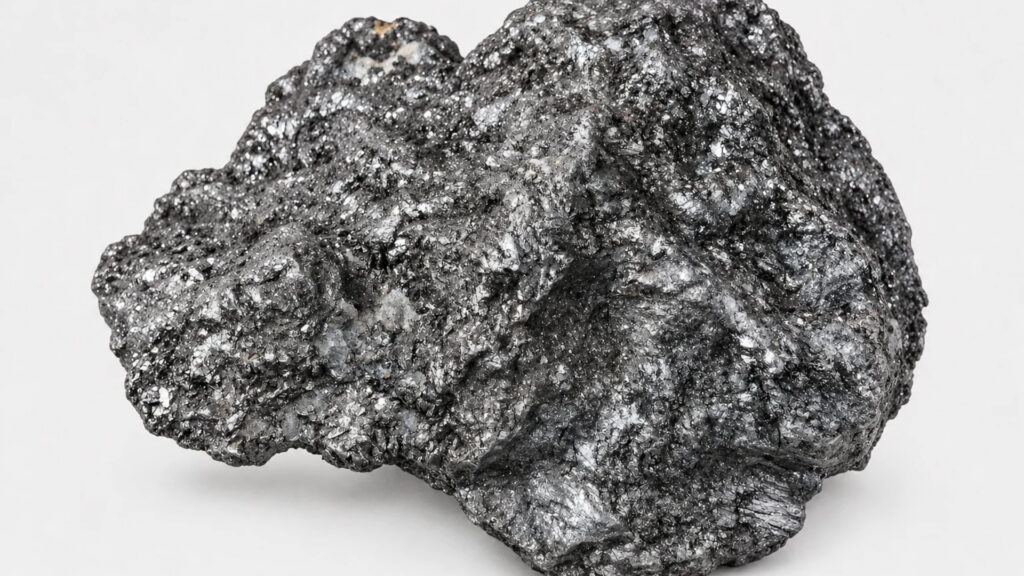
Flake graphite is crystalline and occurs as discrete flakes disseminated through carbonaceous metamorphic rocks – gneisses, schists and marbles. It is the type that matters commercially for batteries and most high-value applications, and it accounts for 80 to 90% of the value of United States natural graphite imports. Finished flake products are graded at 75 to 97% graphitic carbon; the natural flake feeding battery supply chains typically run 85 to 96%. Flake size is graded separately from carbon content, and the two are priced independently.
Amorphous graphite
Amorphous graphite is not truly amorphous; it is microcrystalline. It forms where coal seams have been thermally metamorphosed, usually by contact with an intrusion. Grades in the ore can be high — products run 60 to 90% carbon — but the material is fine-grained and low value. The gap is visible in the trade data: United States imports of amorphous graphite carried an estimated unit value of about US$470 per tonne in 2025, against about US$1,000 per tonne for flake. It goes into refractory mixes, foundry work and pencils, not batteries.
Vein or lump graphite
Vein or lump graphite is the rarest and purest, occurring in veins within high-grade metamorphic regions where it was deposited from carbon-bearing fluids. Products grade 90 to 99.9% carbon and command the highest price of the three — about US$2,600 per tonne for Sri Lankan lump and chip, but global tonnage is tiny. Sri Lanka produced 3,200 tonnes in 2025 and is effectively the only significant commercial source.
What graphite is actually used for
Refractories and steelmaking
This remains the largest traditional market: brake linings, refractories and steelmaking are the major end uses of graphite. Magnesia–carbon bricks line steel ladles and electric arc furnaces; graphite crucibles hold molten metal; graphite electrodes carry the current in electric arc steelmaking. The exploited property is thermal shock resistance; graphite expands very little when heated and conducts heat away quickly, so it does not crack when a furnace is filled with liquid steel.
Battery anodes
In a lithium-ion cell, lithium sits in the cathode and graphite forms the anode. Charging drives lithium ions into the spaces between the graphite sheets (intercalation), and discharging releases them. Roughly 95% of anode material used in lithium-ion batteries is graphite, either natural or synthetic.
Battery-grade material is not simply a clean concentrate. Flake is first milled into rounded particles — spheronisation, first demonstrated in 2000, which rolls crushed flake into roughly 20 µm spheres at an efficiency of about 30 to 50%. Half or more of the feed does not make it into the spherical product. It is then purified, because anode material requires a carbon content above 99%, and a three-stage acid–alkali–acid route can lift graphite from 90% to above 99.9% while preserving the spherical morphology. The same study measured a reversible specific capacity of 350 mAh/g for the purified material against 280 mAh/g for the unpurified material; the purification is not cosmetic.
That yield loss is one of the least-understood economics in the sector, and it is the reason a graphite project’s flake size distribution matters as much as its grade.
Lubricants, brake linings and foundry facings
Graphite lubricates where oil cannot — at high temperature, in vacuum, under load. This group includes high-temperature lubricants, foundry materials, and brushes for electrical motors. It is used dry as a powder, suspended in oils, and bonded into brake and clutch materials.
Nuclear moderation
Graphite lubricates where oil cannot — at high temperature, in vacuum, under load. This group includes high-temperature lubricants, foundry materials, and brushes for electrical motors. It is used dry as a powder, suspended in oils, and bonded into brake and clutch materials.
Graphene and the frontier uses
A single sheet of graphite, one atom thick, is graphene. It is stronger than steel by weight, an excellent conductor, and well enough established that the 2010 Nobel Prize in Physics went to Andre Geim and Konstantin Novoselov for groundbreaking experiments on it. Commercial applications remain narrower than early coverage implied, but composites, coatings, sensors, and membrane technologies are real and growing. For a mining audience, the key point is that graphene comes from graphite, and flake quality directly affects what you can produce.
How graphite forms
Flake graphite is a metamorphic mineral. It begins as organic carbon — buried plant material, algal mats, carbon-rich muds — deposited in sedimentary basins. Burial and heat drive off hydrogen, oxygen and nitrogen, progressively concentrating carbon, and the residual carbon crystallises into graphite. Flake graphite deposits form at or above amphibolite-facies metamorphic conditions, and the most favourable hosts are alumina-rich paragneiss, quartzite and marble at granulite facies, because their granular texture, coarse grain size and low mica content allow large flakes to grow and to be liberated cleanly. Higher metamorphic grade generally produces larger, better-ordered flakes.
That is why graphite exploration is regional-scale geological reasoning before it is anything else. Most flake graphite deposits sit in Precambrian crystalline metamorphic basement of Neoarchean to Proterozoic age, so the first question is whether a terrain is old enough and metamorphosed hard enough, and whether it once contained carbon-rich sediments.
Once the belt is identified, geophysics becomes genuinely useful, because graphite is highly conductive. Electrical methods are a cost-efficient alternative to drilling, and spectral induced polarisation in particular has been shown to relate graphite content and grain size through measurable power-law relationships — meaning a survey can, in the right ground, say something about flake size and not just the presence of a conductor.
In our experience, the caveat matters as much as the capability. Graphite is not the only conductor in a metamorphic belt: disseminated sulphides and graphitic shear zones return comparable responses, and a barren graphitic structure is electrically indistinguishable from an economic flake horizon until it has been drilled. An electromagnetic anomaly is a drill target, not a discovery.
Africa’s graphite: Mozambique, Tanzania and the East African belt
The Mozambique Belt — a high-grade Neoproterozoic metamorphic terrain running through Mozambique, Tanzania and Madagascar — is one of the best flake graphite provinces on Earth, and it is exactly the setting the deposit model predicts. Ancuabe in Mozambique’s Cabo Delgado Province is representative: graphite hosted in biotite gneiss and quartz-rich gneiss of the Lalamo Complex, with a JORC ore reserve of 24.9 Mt at 6.2% total graphitic carbon. Balama sits in the same province. Tanzania’s Mahenge, Epanko and Nachu projects sit in the same belt further north.
The scale is not marginal. Madagascar, Tanzania and Mozambique together produced 215,000 tonnes of natural graphite in 2025 and hold 70 million tonnes of reserves — roughly 23% of the world total. The African Union’s own assessment puts Mozambique, Madagascar and Tanzania at 21% of global graphite reserves.
The strategic position is where it gets uncomfortable. China accounted for 1.4 million of the 1.8 million tonnes of world mine production in 2025, and around 90% of global anode material production sits in China. The African Union states the position plainly: the manufacturing stage of the graphite supply chain does not take place in Africa; graphite concentrate ships overseas—typically to China—and the supply chain leaves Africa at the end of the mining stage. That gap is the central commercial fact about African graphite, and it is where policy pressure is currently concentrated.
Why flake size matters more than grade
Total graphitic carbon is the number that appears in the headline of every graphite announcement, and on its own it tells you very little. Natural graphite is not traded on any commodity exchange; prices are negotiated between buyer and seller and depend on carbon content, flake size and distribution, and the amount and nature of the impurities. Flake size sits alongside grade in that list, not beneath it.
Two deposits with identical TGC can therefore be worth materially different amounts. Coarse fractions sell into specialised markets; fines sell into commodity markets at a fraction of the price. Because flake size varies spatially within an orebody — with metamorphic grade, with structural position, with depth of weathering — it has to be estimated as a set of size fractions by domain, not averaged across the deposit. A single global flake distribution in a resource statement conceals the variable that drives the revenue.
Weathering deserves particular care. Deeply weathered surface ore is a recognised deposit characteristic, and it lowers mining costs, which is why so many East African projects start with a free-digging oxide cap. But oxide and fresh rock rarely behave the same in flotation, and a metallurgical programme built on near-surface material can flatter both recovery and flake size. Test the fresh rock at depth before building a financial model on the numbers.
This is a domaining problem before it is a metallurgical one, and it is the point at which a JORC-compliant resource either holds up under due diligence or does not.
Frequently asked questions
What is graphite used for?
Graphite’s largest markets are brake linings, refractories and steelmaking, where it lines furnaces and forms electrodes, and lithium-ion battery anodes, where it holds lithium ions between its carbon layers. Around 95% of lithium-ion anode material is graphite. It is also used in lubricants, foundry facings, crucibles, electrical brushes, nuclear reactor moderators, pencils and as the feedstock for graphene.
How does graphite form?
Flake graphite forms when carbon-rich sediments are subjected to high-grade regional metamorphism. Heat and pressure drive hydrogen, oxygen and nitrogen out of buried organic matter, and the residual carbon crystallises into graphite at or above amphibolite-facies conditions. Alumina-rich paragneiss, quartzite and marble at granulite facies are the most favourable hosts, because their coarse, granular, mica-poor texture lets large flakes grow. Higher metamorphic grade generally produces larger, better-ordered flakes.
What are the three types of natural graphite?
Natural graphite is classified by crystallinity, grain size and morphology into three ore types. Flake graphite is crystalline, disseminated through metamorphic rocks, and is the type used in batteries. Amorphous graphite is microcrystalline and forms from thermally metamorphosed coal. Vein or lump graphite is a rare high-purity type occurring in veins in high-grade metamorphic terrain and mined almost exclusively in Sri Lanka.
Is there more graphite or lithium in a lithium-ion battery?
Graphite, by a considerable margin. Graphite forms the entire anode of a conventional lithium-ion cell, and the average electric-vehicle battery typically contains 50 to 100 kg of graphite — several times more than it contains lithium, and more than it contains nickel or cobalt.
Where is graphite mined in Africa?
Mostly along the Mozambique Belt, a high-grade metamorphic terrain running through Mozambique, Tanzania and Madagascar. Madagascar produced 80,000 tonnes in 2025, Tanzania 75,000 tonnes and Mozambique 60,000 tonnes, and the three hold 70 million tonnes of reserves between them. Producing and development-stage districts include Balama and Ancuabe in Mozambique and Mahenge, Epanko and Nachu in Tanzania.
Why does flake size matter in a graphite deposit?
Because it sets the price. Natural graphite is not exchange-traded; prices are negotiated and depend on carbon content, flake size and distribution, and impurities. Coarse fractions sell into specialised markets and fines into commodity markets, so two deposits with identical graphitic carbon grades can generate very different revenue. Flake size also varies spatially within an orebody, so it should be estimated by domain rather than reported as a single global figure.
Planning or reviewing a graphite project?
Minrom has taken graphite projects across Africa from early-stage exploration through geological modelling, resource estimation and technical reporting — including the domaining and flake-fraction work that determines whether a project’s numbers hold up under scrutiny. Orom Cross Graphite deposit is but one. Talk to our battery minerals team or book a discovery call.