

















TECHNICAL DUE DILIGENCE
What Investors Should See in
a Strong Mining Technical
Due Diligence Review
Key Takeaways
- Mining due diligence should assess geology, data quality, resource estimation, mine planning, hydrogeology, geometallurgical characterisation, and project risk before capital is committed.
- A mineral resource estimate shouldn’t be accepted at face value. Its geology, modelling assumptions, QA/QC, and resource classification need to be tested.
- Project viability depends on whether geology, mining, processing, and costs hold together at the project’s actual stage.
When capital is close to moving, technical due diligence needs to do more than confirm that a project has a resource statement, a feasibility study, or a polished investor deck. It needs to test whether the project can hold up under scrutiny. That means looking past headline tonnes and grades to the geology, the resource estimate, the mine plan, the hydrogeology, the geometalurgical assumptions, recovery, flow sheet, and the cost base. In addition, the environmental and social issues that could change the value story once money is committed also need to be considered as part of the review.
That’s why mining due diligence shouldn’t be treated as a routine step in a transaction. A weak review can tell you what’s already in the public record. A strong one asks a harder question. What has to be true for this project to deliver what the documents suggest, and where are the assumptions most likely to fail?
Minrom’s own due diligence approach starts from the same premise: geology, geometallurgy, and resource estimation need to be properly understood if risk is going to be reduced and investment decisions are going to rest on a successful project.
Can we insert a quote banner here that reads “At Minrom, we begin every review with rigorous data validation, 3D geological modelling, geometalurgical modelling and hydrogeological assessment, because those early checks often determine how much confidence a project can really support. — Oscar van Antwerpen, Director: Minrom Consulting.”
1. Start with the Geology
The first question, while performing a mining due diligence, isn’t whether the project has a mineral resource estimate. It’s whether the geological interpretation behind that estimate makes sense.
A project can look investable on paper and still rest on weak geological logic. For example:
- The deposit model may be poorly constrained.
- The geological model only considers grade and not metallurgical requirements and or considerations.
- Structural controls may be oversimplified.
- Domain boundaries may be too broad.
- Drill spacing may not support the confidence implied by the classification.
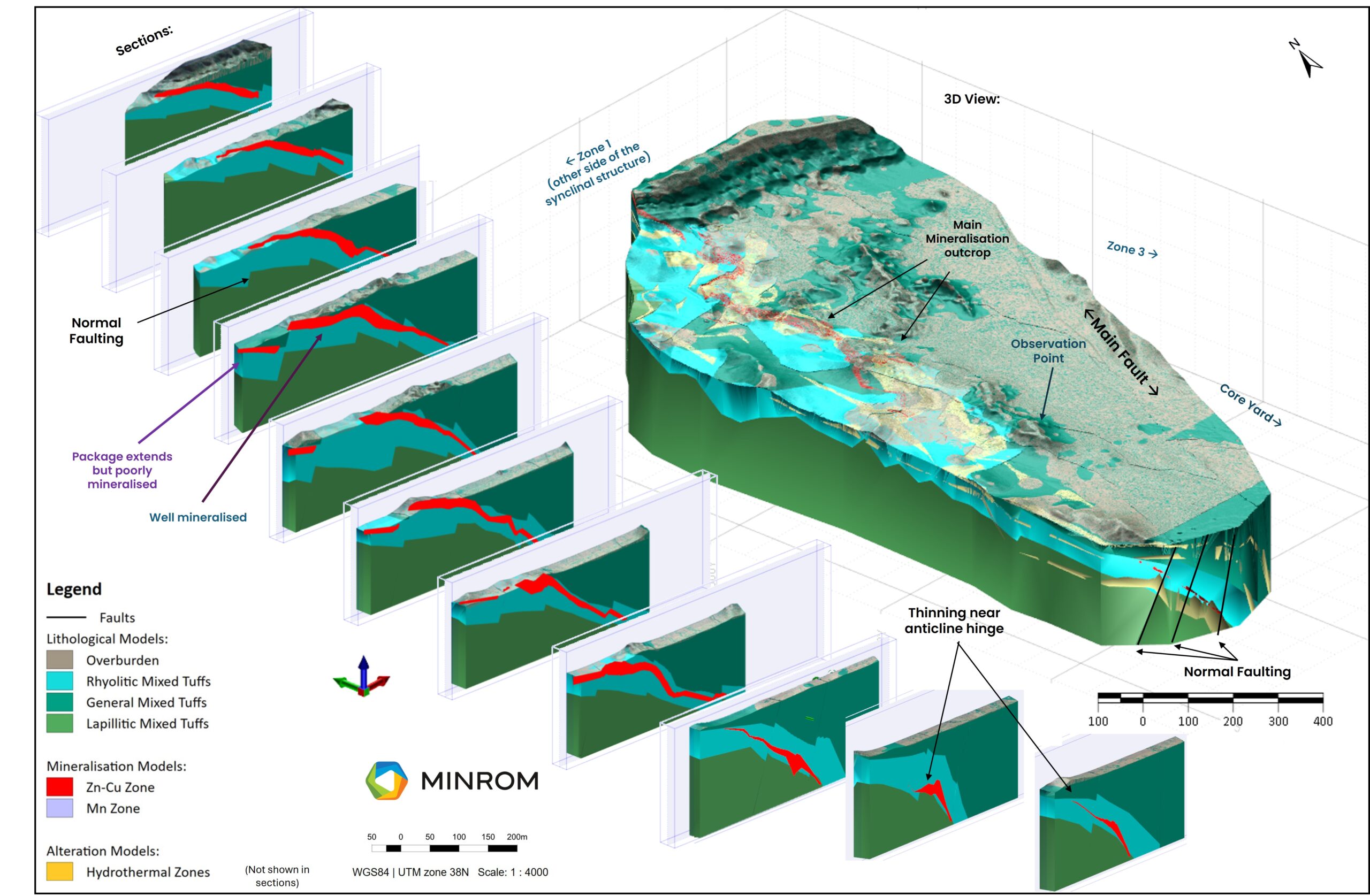
When the geological framework is problematic, the entire mine plan and financial valuation will yield different results. That’s why good due diligence starts with understanding the geology, ore-forming mechanisms, structural controls, metallurgical characteristics, and rock qualities. Minrom’s work in 3D geological and geometallurgical modelling is built around the same principle: the deposit model needs to be coherent and tied to recoverable value:
- How much of the resource is actually likely to be mined?
- How much metal is likely to be recovered in processing?
- Whether ore variability changes recovery rates or costs.
- Whether the model is useful for mine planning and scheduling.
- Whether the project economics hold up once geology and metallurgy are considered together.
That sounds obvious, yet this is where many reviews fail: the geology isn’t assay-grade; there is more to the geological understanding. If the geological model is incorrect and based on poor data, interpretation, and utilisation, it can lead to incorrect planning and failed financial results.
2. Check the Data Quality
Once the geology has been reviewed, the next step is the data that feeds the model. A mining due diligence report shouldn’t treat sampling, assay quality, data verification, and database integrity as background detail. This is the foundation of any project.
An in-depth technical review should ask whether the data is complete, consistent, traceable, and fit for the decisions being made. That includes drilling, sample preparation, analyses, security, and verification. Not only does this process address the risk-based issues, it – importantly – identifies and unlocks potential for the project.
Inconsistent QA/QC, undocumented assumptions, patchy drilling, weak verification, or a database that has grown without consistent controls over time are signs of problematic assumptions underlying the project. A competent reviewer doesn’t just note that data exists. They test whether it can be trusted. We don’t just review data; we validate it, consolidate it into a clean, auditable database, and confirm it’s fit for resource estimation and mine planning.
3. Pressure-test the Mineral Resource Estimate and Modelling Assumptions
A mineral resource estimate doesn’t prove itself just by appearing in a report. A strong review needs to look closely at:
- The estimation method.
- Key assumptions.
- Block model assumptions.
- Interpolation approach.
- Search parameters.
- Capping.
- Density measurements and density parameters.
- Domain controls.
- Understand the link between geological confidence and resource classification.
- Then the big question is whether the work and process are aligned with international reporting codes such as JORC or NI 43-101.
This matters for a simple reason: Investors don’t only lose money on bad deposits. They also lose money on projects where the estimate looked more robust than it really was. The question is, when you want to know that the project will be cash positive: Before or only after implementation. The answer is easy: do your technical work up front as best as you can. This is often less expensive than trying to fix the problem.
So, if the question is how to verify a mineral resource estimate, the answer isn’t to read the number twice. It’s to test the geological model below it, the data feeding it, the estimation choices shaping it, and the classification logic attached to it.
4. Review the Mine Plan, Schedule, and Cost Assumptions Together
A project can have a respectable resource and still fail the viability test. That’s why mining due diligence has to move beyond resource evaluation to include mine design, mining methods, production schedule, recovery assumptions, infrastructure, and cost structure. Reviewing the reserve model and dilution or modifying factors is equally important.
Ore doesn’t create value on its own. Value only appears when geology, mine design, processing, infrastructure, schedule, and economics can produce a nett present positive outcome. A strong review also looks at geometallurgical domains, including how ore characteristics may affect recovery and costs. Geotechnical considerations (pit slopes, underground stability, tailings design) should be reviewed alongside the mine plan to ensure the design is practical and safe.
This is where weak reviews often lose their edge:
- They accept the mining method because it sounds plausible.
- They accept the schedule because it looks neat in a table.
- They accept the costs because they came from a known consultant or an earlier study.
A stronger review asks whether those assumptions still make sense at the project’s current stage, given the current constraints and the quality of the available data.
That’s also why a mining feasibility study isn’t the same thing as a clean bill of health. A study can be detailed and still lean on assumptions that deserve harder testing before money is committed.
5. Don’t Treat Hydrogeology as a Side Issue
Water is often pushed to the edge of the review. That’s a mistake. Hydrogeological risk can reshape mine design, dewatering requirements, slope stability, infrastructure choices, operating costs, permitting, and schedule.
For some projects, hydrogeology isn’t one line in a mining risk assessment. It’s one of the factors that decides whether the plan works at all.
This is where a multidisciplinary review matters. Geology, modelling, hydrogeology, and wider project risk need to be assessed together, since weakness in one area often changes the picture in another. If geology, modelling, water, and mine planning are looked at in isolation, it’s easier to miss the points where they interact. Looking at them together gives a more realistic picture of project viability.
6. Environmental and Social Risk Belongs Inside the Review
Technical due diligence is incomplete if it ignores environmental impacts, social involvement, and, most importantly, the impact of these on the project. An in-depth review should ask whether there are permitting constraints, community risk, stakeholder issues, displacement risk, water-use conflict, or other non-technical factors that could materially affect value, timing, or execution.
This is where some of the largest risks in mining investment sit. Not in the headline grade, but in the gap between the technical plan and the real setting in which that plan has to work.
7. Check Whether the Project is Being Judged at the Right Stage
Project-stage realism is one of the clearest ways to tell the difference between a shallow review and a serious one. An early-stage project shouldn’t be held to the same level of certainty as a mature one. At the same time, it shouldn’t be valued as if that certainty already exists. A strong technical due diligence review should ask whether the confidence, engineering detail, economic modelling, and development expectations match the stage the project is actually at.
This is where capital often gets into trouble. A project that is still largely exploratory is presented as if it’s close to development. A conceptual plan starts to get treated like a likely operating outcome. Assumptions harden into expectations before the supporting work has been done.
A sound review is therefore required to test what the project can achieve, over what time, and at what stage.
Final Thoughts: A Strong Review Should Guide the Decision-Making Process
What should a mining due diligence report include? At a minimum, it should cover geology, data quality, resource estimation, resource classification, geometallurgy, mine planning, processing assumptions, infrastructure, hydrogeology, environmental and social risk, cost structure, and project-stage realism.
The real test is whether the review helps the decision-maker to identify the opportunities (what lies within) and the risks (where project failure could occur).
Minrom’s multidisciplinary approach, combining geology, 3D modelling, geometallurgy, mining geology, and hydrogeology, ensures risks are assessed holistically rather than in silos. But more importantly, we aim to identify the value that lies within. Whether this is a lithium deposit, manganese, iron, copper, cobalt, graphite, or fluorspar project, we follow the same methodology to identify the value that lies within.
Related Services
Exploration Service
Strategy Services
Modelling and GIS Services
Mining Geology Services
Hydrogeology Services
Geology Training Services
Frequently Asked Questions
Mining due diligence usually covers geology, drilling and sampling data, QA/QC, resource estimation, classification, mining method, schedules, processing assumptions, geometallurgy, hydrogeology, environmental and social risk, permitting, infrastructure, costs, and project-stage realism. The aim is to test whether the project’s technical foundation is sound before capital, debt, or acquisition decisions are made.
Investors evaluate mining projects by testing the quality of the geology, the resource estimate, the development pathway, the mining method, cost assumptions, infrastructure needs, water risk, permitting status, and jurisdictional context. They’re trying to judge whether the project is credible, financeable, and appropriately valued for its current stage and risk. Minrom uses this framework as the basis of our due diligence investigations.
The biggest risks in mining investments often sit in poor geological assessments and data work, overstated resource confidence, unrealistic mine plans, poor cost assumptions, water issues, permitting delays, community conflict, and project-stage mismatch. Investors also need to consider datasets that appear complete on paper but don’t support the implied confidence or valuation.
Before investing in a mining project, verify the geological model, data quality, resource estimate, classification, mine plan, schedule, processing assumptions, hydrogeology, permitting, community and environmental risk, and whether the project is being valued at the right stage. A polished report matters less than whether the assumptions actually stand up commercially.
To verify a mineral resource estimate, review the geological interpretation, sampling and QA/QC, database integrity, domaining, structural and mineralogical controls, estimation method, interpolation choices, search parameters, density treatment, capping, classification logic, and reconciliation where available. The key question is whether the model reflects the deposit and supports the level of confidence being claimed publicly.
A mining project becomes viable when geology, mining method, processing, schedule, infrastructure, water, permitting, environmental and social factors, and costs present a positive NPV. Viability isn’t just about grade or size. It also depends on whether the project can be executed, operated, financed, and or managed on assumptions that can support the development of the mining project for the duration of the life of mine. At Minrom we identify key components, drivers, and unique potential value drivers that’ll enhance the project. Minrom has followed this approach in various critical mineral and ferrous metal projects. Our projects are scattered throughout Africa, with a drive in Namibia, Botswana, Zambia, and Zimbabwe.