
















Lithium Deposits: Where the World’s Lithium Actually Comes From
Lithium is the least dense metal on the periodic table — light enough that a block of it floats on water. It also stores more energy per kilogram than any other practical battery material, which is why batteries now account for roughly 88% of world lithium consumption and why a metal few people thought about thirty years ago sits at the centre of energy policy across four continents.
The more interesting question is where it comes from. Roughly 60% of world supply is mined from hard rock — chiefly lithium-rich granitic pegmatites — and the remaining 40% from brines in salt lakes, mostly in Argentina and Chile. The two sources form by unrelated geological processes, are mined by unrelated methods, and carry unrelated risks. In Africa, the answer is almost entirely pegmatite, and that single fact shapes what exploration looks like on the ground and what an investor should be asking.
The truth behind lithium: why “white gold” is a misleading nickname
The nickname is catchy and largely wrong. Lithium carbonate is indeed a white powder, but the comparison with gold breaks down at the point that matters commercially: gold is saleable in the form it is mined in, and lithium is not.
Lithium does not occur as a native element. It sits inside a suite of minerals — spodumene, petalite, lepidolite, amblygonite and eucryptite are the ones that matter — or dissolved in brine, and it has to be crushed, floated, calcined, roasted and precipitated before anything battery-grade exists. Understanding which of those minerals actually hosts the lithium is, in the words of the British Geological Survey’s review of African lithium pegmatites, “critically important for mining”.
The value therefore appears at the end of the chain, not at the drill bit. The gap is not small: in 2025 the USGS recorded Australian spodumene concentrate at roughly US$800 to US$970 per tonne while battery-grade lithium carbonate in China traded at around US$9,300 to US$10,300 per tonne. A press release announcing a high-grade lithium intersection therefore tells you far less than the equivalent announcement would for gold. Grade is one input. Mineralogy, crystal size and whether the material can be concentrated economically are the others.
The two deposit types that supply almost all commercial lithium
Hard-rock pegmatites
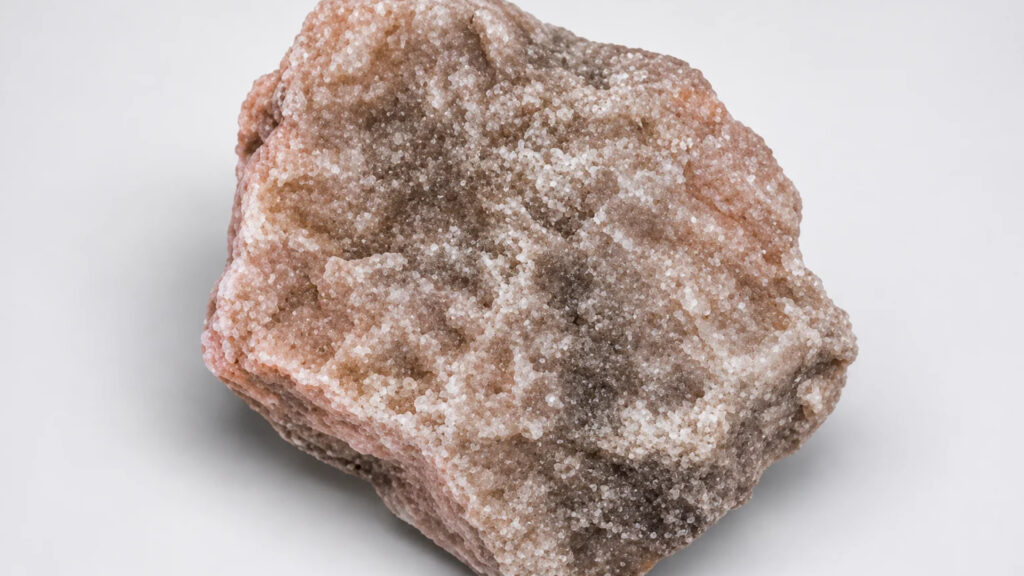
Pegmatites are very coarse-grained igneous rocks, most commonly granitic in composition, distinguished from ordinary igneous rocks by extreme and highly variable grain size and by textures such as directional crystal growth, mineral zonation and graphic intergrowths. The USGS deposit model puts it more plainly still: a pegmatite is an igneous rock “distinguished from other igneous rocks by its extremely coarse but variable grain-size”, occurring “as sharply bounded homogeneous to zoned bodies” within igneous or metamorphic host rocks. Crystals are measured in centimetres and metres rather than millimetres.
Not all pegmatites carry lithium. The ones that do belong to the LCT family — lithium, caesium, tantalum — under the classification of Černý and Ercit, which remains the standard scheme. LCT pegmatites are “the most highly differentiated products and last magmatic components to crystallise from calc-alkaline granitic melts”, derived mainly from peraluminous S-type granites. As a granite body solidifies, the elements that do not fit comfortably into ordinary rock-forming minerals are progressively concentrated into the residual melt: lithium, caesium and tantalum, and alongside them rubidium, beryllium, tin, boron, phosphorus and fluorine. That melt crystallises slowly and in the presence of water, which is what produces the enormous crystals.
Spodumene is the ore mineral that matters most commercially, because the cracking and refining routes for it are well established. A hard-rock operation does not sell lithium; it sells a concentrate at about 6% lithium oxide (Li₂O), the specification the USGS uses for its benchmark spodumene price series and which the trade abbreviates to SC6. That concentrate is usually converted into lithium hydroxide or carbonate elsewhere, often on another continent.
Continental brines
Continental brines occupy closed basins in arid, high-altitude terrain, where lithium leached from surrounding volcanic rocks accumulates in groundwater beneath a salt flat over geological time. The brine is pumped into evaporation ponds and concentrated by sun and wind before processing into lithium carbonate. The route is slow and water-hungry: a review in Nature Reviews Earth & Environment describes evaporitic technology as long questioned on three counts — its intensive water use, its protracted duration, and the fact that it can only be applied to continental brines at all.
Capital cost per tonne tends to be lower than hard rock, but the production ramp is longer, output is sensitive to rainfall, and the water-use profile is politically contentious in precisely the arid regions where these deposits occur. The major brine resources are in South America’s lithium triangle and in China. Africa has none of consequence.
The third and fourth routes: clays and geothermal brine
Lithium-bearing clays such as hectorite and related smectites, and geothermal brines, are both real resources that have attracted serious investment. Neither yet supplies material tonnage: the USGS lists lithium-clay sources as in development or exploration only in Mexico and the United States. Direct lithium extraction (DLE) is the technology most likely to change the picture because it aims to avoid brine evaporation altogether, and a selection of DLE technologies has achieved lithium recovery above 95% in testing. It is worth watching closely, but the same review is careful about how far that evidence extends: only 30% of DLE test experiments were run on real brines rather than synthetic ones, and some DLE routes heat the brine to as much as 80 °C or adjust its pH, which consumes energy, fresh water and chemicals of its own. It is not yet something to build a project’s economics on.
How a lithium pegmatite forms — and why that is an exploration method
The formation story matters because it doubles as a search method. LCT pegmatites are the final, most fractionated expression of a fertile parent granite, and they rarely occur alone. Fields typically show regional mineralogical and geochemical zoning relative to the inferred parental granite, with the greatest enrichment in the more distal pegmatites. The practical corollary from the same USGS model is blunt and useful: new LCT pegmatites are most likely to be found near known ones.
That zonation is measurable, which is what turns geology into a vector. The USGS lists the mineral-chemical trends in ordinary pegmatites that point towards an evolved LCT body: increasing rubidium in potassium feldspar, increasing lithium in white mica, increasing manganese in garnet, and increasing tantalum and manganese in columbite–tantalite — in ratio terms, a falling K/Rb and a falling Nb/Ta. The African review applies the same indicators, using Rb/Cs and Nb/Ta to demonstrate increasing fractionation outward through a batholith and extreme melt fractionation in the Ghanaian and Ivorian fields. A geologist can therefore sample an apparently barren pegmatite, establish how evolved it is, and decide which way to walk.
Internal zonation matters just as much. Most LCT bodies show four zones — border, wall, intermediate (where lithium, caesium and tantalum are generally concentrated) and core — expressed in both cross-section and map view, so that “what may appear to be a common pegmatite may instead be the edge of a mineralised body”. Sampling the wrong part of the outcrop is one of the more expensive ways to walk away from a discovery.
This is also why lithium exploration in pegmatite terrain remains largely a mapping and sampling exercise. The USGS states flatly that LCT pegmatites “do not have a strong geophysical signature”, because their granitic composition is not sufficiently different from that of common host rocks. Geophysics is not useless — regional aeromagnetic data defined a five-kilometre-wide pegmatite corridor at Manono in the DRC — but it is a framing tool, not a detector. Hyperspectral and portable analytical instruments help confirm spodumene once you are standing on it. Finding the field in the first place still comes down to applying geological reasoning to outcrop.
Africa’s lithium: where it is and why it is pegmatite country
Africa is well endowed with lithium and almost all of it is hard rock. The British Geological Survey’s 2025 review describes a continent hosting significant but largely untapped lithium resources, in which every major orogenic event has left a distinct pegmatite fingerprint: Archaean pegmatites are typically petalite-dominated, unzoned spodumene pegmatites are common in the Palaeoproterozoic of the West African craton, Mesoproterozoic pegmatites in Central Africa are tin–tantalum rich, and complex zoned pegmatites are more common in the Neoproterozoic to Palaeozoic orogens.
Zimbabwe is the continent’s largest producer. USGS figures for 2025 put Zimbabwean output at 28,000 tonnes of contained lithium from five mineral operations, up from 20,000 tonnes in 2024 — ahead of Argentina, and fourth in the world behind Australia, China and Chile. The Zimbabwe craton is exceptionally rich in lithium pegmatites, with 29 occurrences catalogued and the majority sitting within the Archaean cratonic core. The best known is Bikita, which intrudes the Masvingo greenstone belt and is dated at 2,617 ± 1 million years. Mining there began when tin was discovered in 1910, and petalite mining started in the 1940s and has been the mainstay ever since. Bikita carries a reported resource of 113.35 Mt at 1.03% Li₂O; Arcadia, north-east of Harare, holds 72.7 Mt at 1.06%.
The Democratic Republic of the Congo hosts Manono–Kitotolo, a large network of sheet-like pegmatites cropping out over 13.5 kilometres with a thickness of around 300 metres, dated at 945 to 930 million years, carrying a JORC resource of 842 Mt at 1.61% Li₂O — the largest lithium pegmatite resource reported anywhere in Africa, and among the largest reported anywhere. The alluvial and eluvial cover over those pegmatites was mined for tin between 1915 and the 1980s.
Mali has moved from prospect to producer: two operations started in 2024, and output reached 9,400 tonnes in 2025. Goulamina reports 267 Mt at 1.38% Li₂O and Bougouni 31.9 Mt at 1.06%. Ghana’s Ewoyaa reports 35.3 Mt at 1.25%. Namibia has Uis at 81 Mt at 0.73% and Karibib at 11.85 Mt at 0.4%, although the USGS temporarily removed Namibia from its mine production table because of legal uncertainties. Namibia’s Karibib–Uis belt has a long tin and tantalum history, which is no coincidence: it is exactly the tin–tantalum-rich Mesoproterozoic signature the review describes.
The continent is pegmatite country rather than brine country for structural reasons. Brines require closed, arid basins with the right volcanic input and a very long accumulation period. Africa’s Archaean and Proterozoic cratons are old, deeply eroded granitic terrain that exposes pegmatite swarms at the surface instead. Much of the prospective ground has never been systematically explored for lithium because geologists mapped it decades ago looking for something else. Kamativi in north-western Zimbabwe is the clearest illustration: it was mined for tin from 1936 to 1994, and the lithium minerals were never extracted at all.
What makes a lithium resource difficult to estimate
Pegmatite-hosted lithium is awkward to model, and teams used to disseminated or stratabound orebodies routinely underestimate how awkward. For context on scale, a USGS grade-and-tonnage dataset covering 73 pegmatite-hosted deposits worldwide returns a median of 21.2 Mt at 1.12% Li₂O — these are not large targets by base-metal standards, and small geometric errors matter disproportionately.
Geometry and domaining. Pegmatite dykes are narrow, often steeply dipping and internally zoned, so grade continuity is controlled by structure and internal mineralogy rather than by the statistical behaviour of the sample set. Fitting a variogram across a pegmatite contact describes a feature that does not exist. SRK’s summary of commonly observed issues on lithium pegmatite projects makes the point directly: resource risk assessment requires evaluating dyke mineralogy, texture and chemistry alongside dyke geometry, continuity, internal dilution and cross-cutting features, and most projects need detailed structural assessment, geometallurgical domain characterisation, tight-spaced diamond drilling and deposit-scale 3D modelling before mine planning is credible.
Lithium deportment. A whole-rock assay reports lithium regardless of what mineral it is sitting in, and different hosts behave completely differently in a flotation circuit. Lithium locked in mica is not lithium in coarse spodumene. The problem is not theoretical: where petalite was the original magmatic mineral, it may be replaced by a spodumene–quartz intergrowth as the pegmatite cools, and at Kamativi spodumene has been replaced by fine-grained micas, zeolites and clays. Reporting a resource on assays alone, without mineralogical work establishing where the lithium actually resides, embeds a metallurgical assumption the plant may not honour.
Bulk density. Pegmatites vary substantially in density between zones. Applying one global density value across a zoned body produces tonnage errors that no amount of additional grade precision will correct.
None of this is exotic; it is standard practice, and it is precisely what a JORC-compliant resource estimate exists to force. It is also why so many early-stage lithium resources are revised downwards once they are reviewed properly.
From concentrate to battery: what actually gets sold
A hard-rock lithium mine sells spodumene concentrate, not lithium. Turning that concentrate into a battery chemical begins with calcination, because spodumene occurs naturally in a dense, less reactive α-phase, and heat treatment above 950 °C is required to transform it into the more reactive β-phase. The β-phase is around 30% less densely packed and far more brittle than the α-phase, which is why calcined material behaves differently in downstream processing. It is then digested in concentrated sulphuric acid to produce water-soluble lithium sulphate, which is purified and precipitated into lithium carbonate or converted to lithium hydroxide.
Which of the two the market wants depends on the cathode. Lithium iron phosphate (LFP) chemistries use carbonate, while high-nickel NMC and NCA cathodes increasingly require hydroxide, because hydroxide is more reactive at the lower sintering temperatures those cathodes need.
Conversion is where most of the value sits — recall the roughly tenfold gap between concentrate and carbonate prices above — and Africa has very little conversion capacity. Every African lithium project therefore carries a policy question alongside its geological one: export the concentrate, or convert onshore? Governments are increasingly deciding that question for the industry. Zimbabwe had scheduled a ban on lithium concentrate exports for January 2027; in February 2026 it went further and suspended exports of all raw minerals and lithium concentrates with immediate effect, including material already in transit. The country had exported 1.128 million tonnes of spodumene concentrate in the year to December 2025, most of it to China. The response has been onshore capacity: Huayou has built a US$400 million plant converting concentrate to lithium sulphate, and Sinomine has announced a US$500 million sulphate plant at Bikita. That is not a marginal adjustment to a financial model. It changes the project.
Frequently asked questions
Where does lithium come from?
Almost all commercial lithium comes from one of two sources. Around 60% is mined from hard-rock pegmatites, and 40% from continental brines. In pegmatites, lithium sits in minerals such as spodumene, petalite, and lepidolite; in brines, it is dissolved in groundwater beneath salt flats in arid closed basins. Pegmatites supply Australia, Zimbabwe and the rest of Africa; brines supply Chile, Argentina and Bolivia.
What is a pegmatite?
A pegmatite is a very coarse-grained igneous rock, usually granitic in composition, that forms from the last and most chemically evolved fraction of a crystallising granitic magma. That residual melt concentrates elements excluded from ordinary rock-forming minerals, which is why pegmatites of the LCT family — named for lithium, caesium and tantalum in the Černý and Ercit classification — carry commercially meaningful lithium. Crystals are measured in centimetres and metres, not millimetres.
Does Africa have lithium?
Yes, and almost all of it is hard rock. Zimbabwe is the continent’s largest producer, at 28,000 tonnes of contained lithium in 2025, and has mined the Bikita pegmatite field since petalite mining began there in the 1940s. The DRC hosts Manono–Kitotolo, with a reported JORC resource of 842 Mt at 1.61% Li₂O — the largest lithium pegmatite resource reported in Africa. Mali is now producing, and Ghana and Namibia have projects at various stages.
What is the difference between hard-rock and brine lithium?
Hard-rock lithium is mined conventionally, concentrated to roughly 6% Li₂O and then chemically converted into lithium carbonate or hydroxide. Brine lithium is pumped as a liquid and concentrated in evaporation ponds, a route long criticised for its intensive water use and its protracted duration. Hard rock carries higher operating costs but ramps up faster; brine has lower operating costs but longer lead times and materially greater water-use risk.
Why is lithium called white gold?
The nickname reflects the white colour of lithium carbonate and the metal’s importance to the energy transition. It misleads in one important respect: unlike gold, lithium has no value in the form it is mined in, because it never occurs as a native element and must be concentrated and chemically converted before it is worth anything. That is why grade alone is a poor guide to the value of a lithium intersection.
Evaluating a lithium pegmatite project?
Minrom has delivered projects across lithium, graphite, rare earth elements, nickel, copper and cobalt in Africa, from early-stage exploration programme design through geological modelling, resource estimation and technical reporting. If you are evaluating a pegmatite project — your own or someone else’s — our battery minerals consulting team can help. Book a discovery call.