

















CASE STUDY
Technical Due Diligence for a Copper-Cobalt Deposit in the DRC
Project Overview
Minrom Consulting conducted a technical due diligence audit for a copper-cobalt mining operation in the Democratic Republic of the Congo to validate mineral resource data against NI 43-101 reporting standards. The project involved geological model verification, grade re-estimation, and data validation to improve resource confidence, identify estimation issues, and support stronger long-term mineral resource management.
Scope of Work
Key Takeaways
- This project details a formal technical audit conducted by Minrom Consulting for a copper and cobalt mining operation in the Democratic Republic of the Congo. To ensure compliance with international NI 43-101 reporting standards, Minrom performed a rigorous data validation process that involved verifying geological models and re-calculating mineral grade estimations.
- The investigation concluded with a series of strategic recommendations aimed at improving the mine’s resource management, such as addressing artisanal mining impacts and implementing a centralized data system.
- Services Provided: NI 43-101 resource validation | Geological model verification | Geostatistical analysis | Grade re-estimation | Data validation | Mineral Resource Management recommendations
Commodity
Copper-Cobalt (Cu-Co)
Country
DRC, Africa
Project Type
Due Diligence

Project Geological Context
Minrom Consulting was contracted by well-known Cu-Co mine to perform an audit on the technical data used to estimate a particular mine’s mineral resource based on the National Instrument (NI) 43-101 standards for reporting an exploration result for mineral resources and ore reserves.
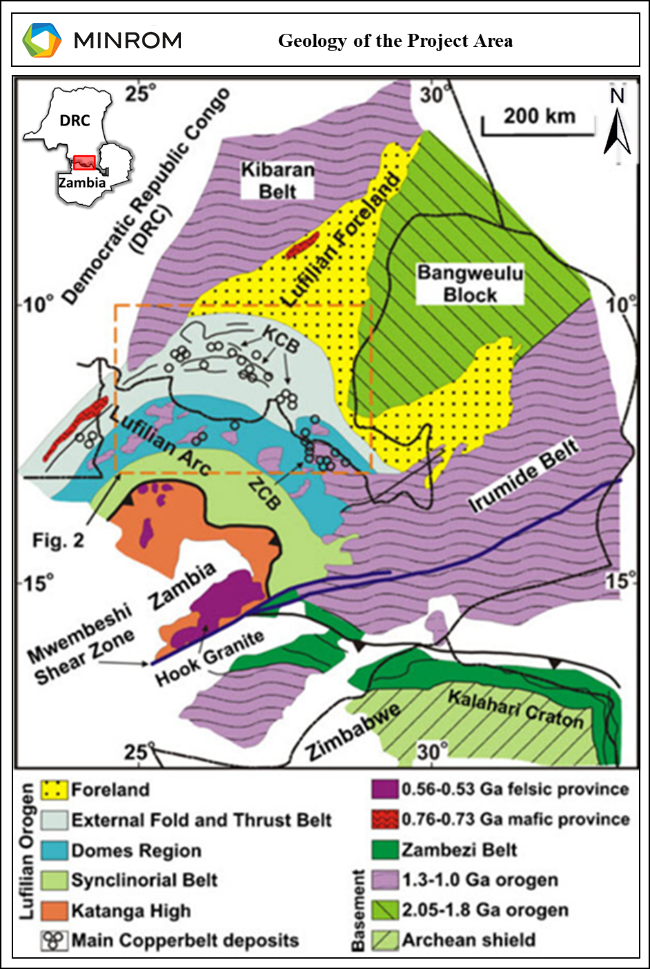
The African Copper Belt, the Lufilian Arc, stretches from the south-eastern part of the DRC into northern Zambia. The copper mineralization is hosted within the Neoproterozoic Katanga succession deposited within an evaporative basin between the Congo and Kalahari Basin. The Cu-Co ore mineralization within the Katanga Copper Belt is hosted within the Mines Subgroup of the Katanga Supergroup. The sedimentary successions within the Katanga Supergroup are characterised as cyclical carbonate- and clastic-dominant layers deposited within an evaporative basin facies environment with deposition starting around 880 Ma. The project area mine property is located in the external fold-and-thrust belt of the Lufilian Orogenic Belt. Copper and cobalt mineralisation occurs as three strata bound ore zones within dolomitic shales and silicified dolomites of the Mines Supergroups.
Technical Validation Process
Minrom validated the technical data gathered from the mine which included the geological and mineralisation interpretations and modelling; geostatistical estimations and parameters used to develop the block models and reports mineral; to report the mineral resources inventory for the mines copper and cobalt deposits.
The data validation process implemented project area deposits included the visual verification of the bore hole collar positions, re-analysing some sample reject material, validating both mines databases, validating the geological and mineralisation model, analysing and re-estimating geostatistical parameters, and re-estimating grade block models.
Key Findings and Recommendations
Minrom recommended the following to the client:
- Review the dilution factors of the resource base by artisanal mining,
- Survey the mines float discard dumps,
- Correct the ore grade estimations where problems were detected in over- and under-estimations,
- Develop an ore metallurgical model where optimal extraction be modelled and placed in the mine plan,
- Implement a Mineral Resource Management System and data management system.
Figure 1
Geology of the project area.
Project Geological Context
Minrom Consulting was contracted by well-known Cu-Co mine to perform an audit on the technical data used to estimate a particular mine’s mineral resource based on the National Instrument (NI) 43-101 standards for reporting an exploration result for mineral resources and ore reserves.
The African Copper Belt, the Lufilian Arc, stretches from the south-eastern part of the DRC into northern Zambia. The copper mineralization is hosted within the Neoproterozoic Katanga succession deposited within an evaporative basin between the Congo and Kalahari Basin. The Cu-Co ore mineralization within the Katanga Copper Belt is hosted within the Mines Subgroup of the Katanga Supergroup. The sedimentary successions within the Katanga Supergroup are characterised as cyclical carbonate- and clastic-dominant layers deposited within an evaporative basin facies environment with deposition starting around 880 Ma. The project area mine property is located in the external fold-and-thrust belt of the Lufilian Orogenic Belt. Copper and cobalt mineralisation occurs as three strata bound ore zones within dolomitic shales and silicified dolomites of the Mines Supergroups.
Figure 1
Geology of the project area.
Technical Validation Process
Minrom validated the technical data gathered from the mine, which included the geological and mineralisation interpretations and modelling; geostatistical estimations and parameters used to develop the block models; and reports on the mineral resources inventory for the mine’s copper and cobalt deposits.
The data validation process implemented project area deposits included the visual verification of the bore hole collar positions, re-analysing some sample reject material, validating both mines databases, validating the geological and mineralisation model, analysing and re-estimating geostatistical parameters, and re-estimating grade block models.
Key Findings and Recommendations
Minrom recommended the following to the client:
- Review the dilution factors of the resource base by artisanal mining,
- Survey the mines float discard dumps,
- Correct the ore grade estimations where problems were detected on over and under estimations,
- Develop an ore metallurgical model where optimal extraction be modelled and placed in the mine plan,
- Implement a Mineral Resource Management System and data management system.