


















CASE STUDY
Advancing a DRC Cu-Co Project Through Phased Exploration
Scope of Work
Key takeaways
- Minrom Consulting carried out a multi-phase exploration campaign following a review of historical exploration data and initial geological modelling of a Cu-Co prospect in the Democratic Republic of Congo (DRC)
- Phased drilling campaigns allowed Minrom to verify historical data and generate new drilling data to produce an updated Mineral Resource Estimate that showed a 44% increase in resource tonnage
- Metallurgical studies indicate that the mineralised Cu-Co lithologies are amenable to conventional acid leaching processing techniques and highlight the economic potential of the project
Commodity
Copper (Cu), Cobalt (Co)
Country
Democratic Republic of Congo (DRC)
Project Type
Exploration

Project overview
Minrom was contracted to evaluate Cu-Co potential for a project in southern DRC based on historical exploration results. A thorough review of this historical data helped unlock hidden project potential and ultimately led to a multi-phase exploration program.
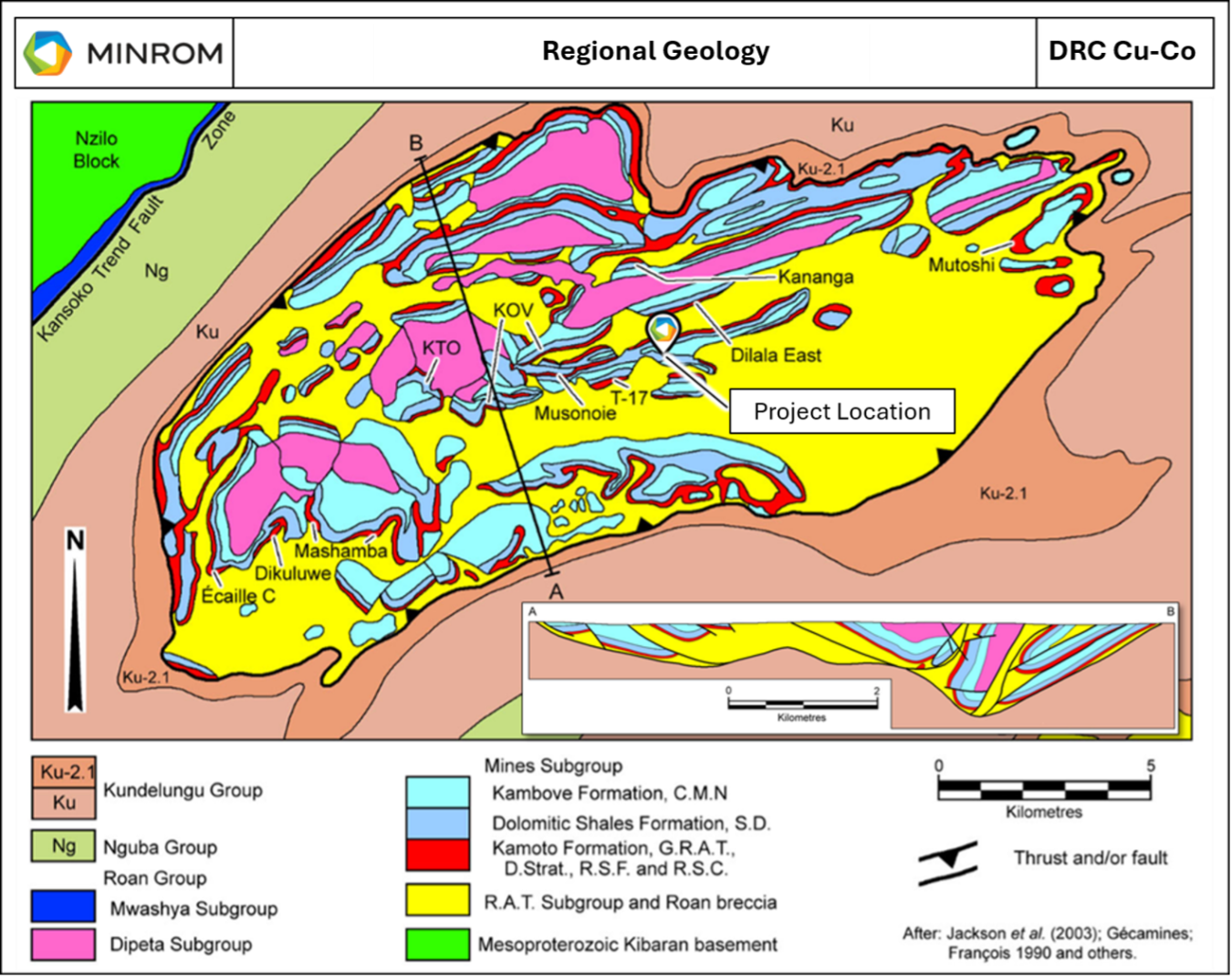
The DRC Cu-Co Project is located near the town of Kolwezi within the Lualaba Province. Geologically, the project is situated within the Katanga Supergroup (Figure 1).
Phase 1 – Gap Analysis
This initial project phase helped to understand the gap between where the project currently stands and the end goal of defining a Mineral Resource based on the data available. Historical exploration results and relevant open-source data were compiled before Minrom recommended further investigation into the Cu-Co potential.
Phase 2 – Geological Model & Range Analysis
A geological model was constructed based on historical drilling results with the model being used to carry out a range analysis for the project area. This analysis helped our client to understand the Cu-Co potential for the project as well as the potential risk.
Phase 3 – Twin Drilling & Metallurgical Studies
A 1 070 m twin drilling campaign was completed to verify the accuracy and precision of historical data and therefore evaluate the potential risk of the geological model and mineralisation potential evaluated in the preceding phase.
Given the positive Cu-Co mineralisation seen by Minrom’s on site team during the twin drilling programme it was recommended that samples be sent for metallurgical analysis. An acid-soluble analyses performed on the samples determined the amount of copper and cobalt which can theoretically be extracted by means of conventional acid leaching processes. The resulting TCu-TCo ratio calculations suggest that most of the samples report above 70% acid solubility and should react favourably to acid-leaching processes.
Phase 4 & 5 – Oxide & Sulphide Drilling Campaigns with Mineral Resource Estimation
Having confidence in the historical data and processability of Cu-Co material it was decided that further drilling be completed to allow for an updated Mineral Resource Estimation.
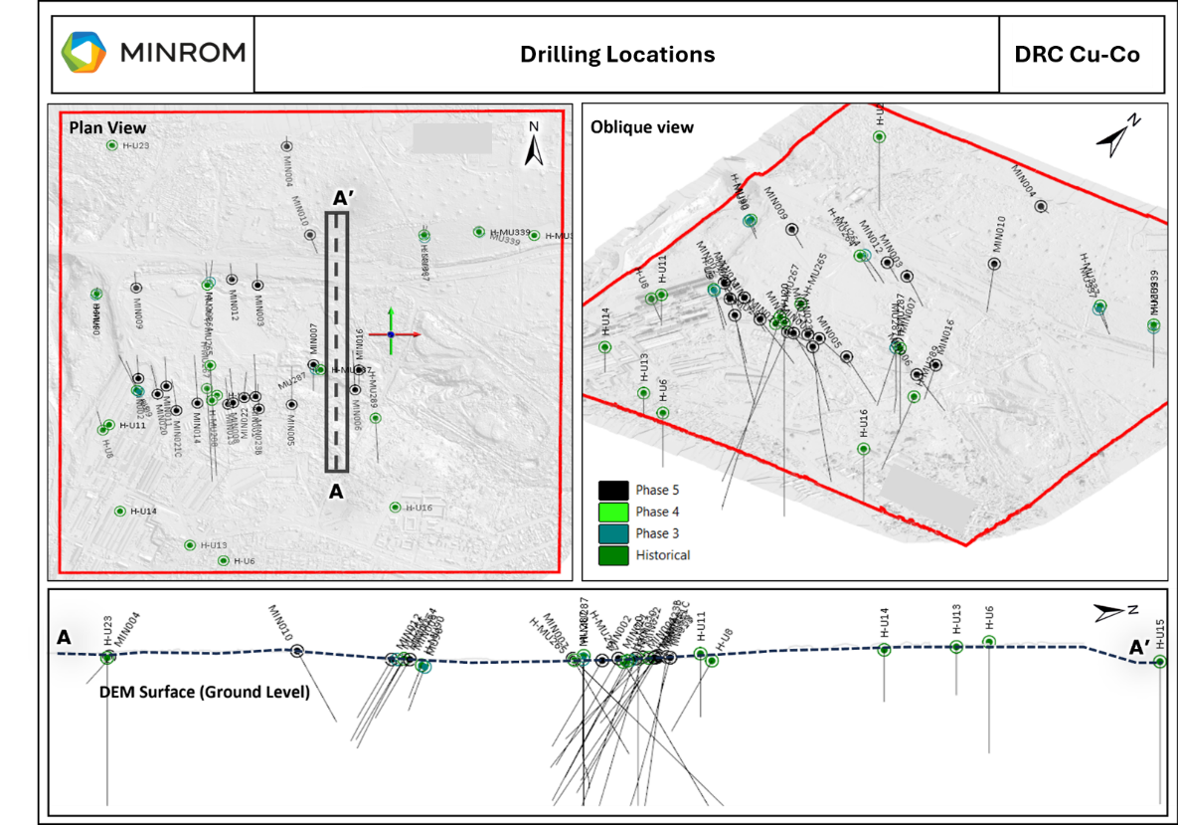
Drilling was broken into two phases with the first focussing on shallower oxide mineralisation and the second focussing on deeper sulphide mineralisation. A total of 4844 m of diamond core drilling was completed with 1281 samples (including QAQC samples) being sent for multi-element ICP analysis (Figure 2).
Figure 1
Regional Geology of the DRC Cu-Co Project.
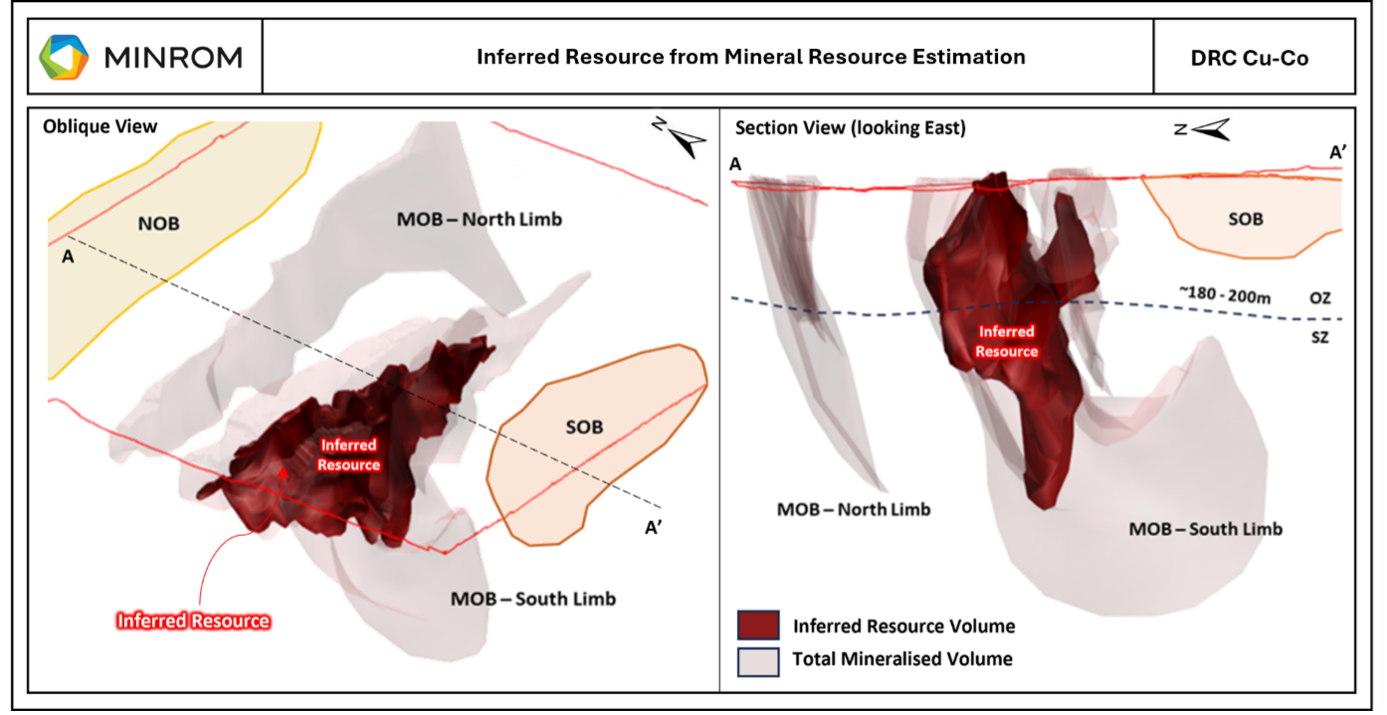
New and historical drilling data was compiled into one database for geological modelling and mineral resource estimation. The resultant Inferred Resource showed a 44% tonnage increase from the previous MRE with average grades of the material at 1.67 % Cu and 0.23 % Co (Figure 3).
Figure 2
Drilling locations for the DRC Cu-Co Project.
The work carried out by Minrom took place over a four-year period and represents the time and dedication required to deliver high-quality insights for sound decision making. A combination of old and new data helped advance an early-stage exploration project to the point of a conceptual mining study where the project currently stands. Further drilling and metallurgical studies have also been recommended by Minrom.
Figure 3
Modelled Inferred Resource Area for the DRC Cu-Co Project
Project overview
Minrom was contracted to evaluate Cu-Co potential for a project in southern DRC based on historical exploration results. A thorough review of this historical data helped unlock hidden project potential and ultimately led to a multi-phase exploration program.
The DRC Cu-Co Project is located near the town of Kolwezi within the Lualaba Province. Geologically, the project is situated within the Katanga Supergroup (Figure 1).
Figure 1
Regional Geology of the DRC Cu-Co Project.
Phase 1 – Gap Analysis
This initial project phase helped to understand the gap between where the project currently stands and the end goal of defining a Mineral Resource based on the data available. Historical exploration results and relevant open-source data were compiled before Minrom recommended further investigation into the Cu-Co potential.
Phase 2 – Geological Model & Range Analysis
A geological model was constructed based on historical drilling results with the model being used to carry out a range analysis for the project area. This analysis helped our client to understand the Cu-Co potential for the project as well as the potential risk.
Phase 3 – Twin Drilling & Metallurgical Studies
A 1 070 m twin drilling campaign was completed to verify the accuracy and precision of historical data and therefore evaluate the potential risk of the geological model and mineralisation potential evaluated in the preceding phase.
Given the positive Cu-Co mineralisation seen by Minrom’s on site team during the twin drilling programme it was recommended that samples be sent for metallurgical analysis. An acid-soluble analyses performed on the samples determined the amount of copper and cobalt which can theoretically be extracted by means of conventional acid leaching processes. The resulting TCu-TCo ratio calculations suggest that most of the samples report above 70% acid solubility and should react favourably to acid-leaching processes.
Phase 4 & 5 – Oxide & Sulphide Drilling Campaigns with Mineral Resource Estimation
Having confidence in the historical data and processability of Cu-Co material it was decided that further drilling be completed to allow for an updated Mineral Resource Estimation.
Drilling was broken into two phases with the first focussing on shallower oxide mineralisation and the second focussing on deeper sulphide mineralisation. A total of 4844 m of diamond core drilling was completed with 1281 samples (including QAQC samples) being sent for multi-element ICP analysis (Figure 2).
Figure 2
Drilling locations for the DRC Cu-Co Project.
New and historical drilling data was compiled into one database for geological modelling and mineral resource estimation. The resultant Inferred Resource showed a 44% tonnage increase from the previous MRE with average grades of the material at 1.67 % Cu and 0.23 % Co (Figure 3).
Figure 3
Modelled Inferred Resource Area for the DRC Cu-Co Project.
The work carried out by Minrom took place over a four-year period and represents the time and dedication required to deliver high-quality insights for sound decision making. A combination of old and new data helped advance an early-stage exploration project to the point of a conceptual mining study where the project currently stands. Further drilling and metallurgical studies have also been recommended by Minrom.