


















CASE STUDY
Graphite and gold in Cabo Delgado, Mozambique: non-invasive exploration project case study
Minrom Consulting completed an early-stage exploration program for graphite and gold mineralization in Cabo Delgado Province, Mozambique. The work combined geological mapping, geochemical sampling, trenching, airborne geophysics, and follow-up soil sampling to identify mineralized zones, test possible extensions, and refine target areas for further exploration.
Scope of Work
Key takeaways
- Minrom explored graphite and gold targets in Cabo Delgado Province, Mozambique.
- Mapping, sampling, trenching, geophysics, and soil sampling helped refine mineralized target areas.
- The project targeted graphite-bearing mica schist and gneiss units within the Xixano Complex.
- Minrom recommended further trenching and pitting to test grade continuity.
Commodity
Gold (Au), Graphite (C)
Country
Mozambique
Project Type
Non-invasive Exploration

Project Overview
Minrom Consulting performed a non-invasive exploration programme in Cabo Delgado Province, Mozambique, to investigate graphite and gold mineralisation.
Mozambique is a proven graphite region with the country having an 8% share of global reserves and a 6 % share of global production. The Balama mine opened in 2017 and was planned for full capacity of 356,000 tonnes per year of graphite concentrate, according to the USGS. The USGS also records the reopening of the Ancuabe mine in 2017.
For this project, Minrom’s role was to design and carry out a field-based exploration program that could narrow the target areas and guide the next phase of work.Minrom Consulting completed an early-stage exploration program for graphite and gold mineralization in Cabo Delgado Province, Mozambique. The work combined geological mapping, geochemical sampling, trenching, airborne geophysics, and follow-up soil sampling to identify mineralized zones, test possible extensions, and refine target areas for further exploration.
Geological setting of the Cabo Delgado graphite and gold project
Geologically, the project is situated within the high-grade metamorphic complex of the Pan-African Mozambique Belt. These highly metamorphosed rocks have been overlain by Karoo sedimentary formations to the west and sediments of the Rovuma Group to the east. Syn-orogenic to post-orogenic plutonic intrusive rocks (pegmatites and deformed granites) are readily found throughout the region. Regionally, there are three (3) important lithostratigraphic units: the Xixano Complex, the Nairoto Complex and the Montepuez Complex.
The project is located within the Neoproterozoic Xixano Complex which is primarily composed of high-grade metamorphic units such as paragneisses, amphibolites, and granulitic rocks. On the local scale, target lithologies were regionally mapped graphite-bearing mica schist and gneiss units with some of these graphitic units also playing host to gold mineralisation. This mineralisation may represent an extension of that seen in the Niassa Gold Belt (NGB) in northern Mozambique.
Regional Geology
The exploration programme developed and implemented by Minrom comprised of on-site geological mapping and geochemical sampling which included trenching over the identified mineralised zones. A subsequent airborne geophysical survey was implemented to assist in highlighting potential extensions to mineralised zones and identifying any additional targets within the project area. A follow-up soil sampling campaign was performed to assess possible mineralisation trends and narrow the prospective target areas for graphite and gold.
Figure 1
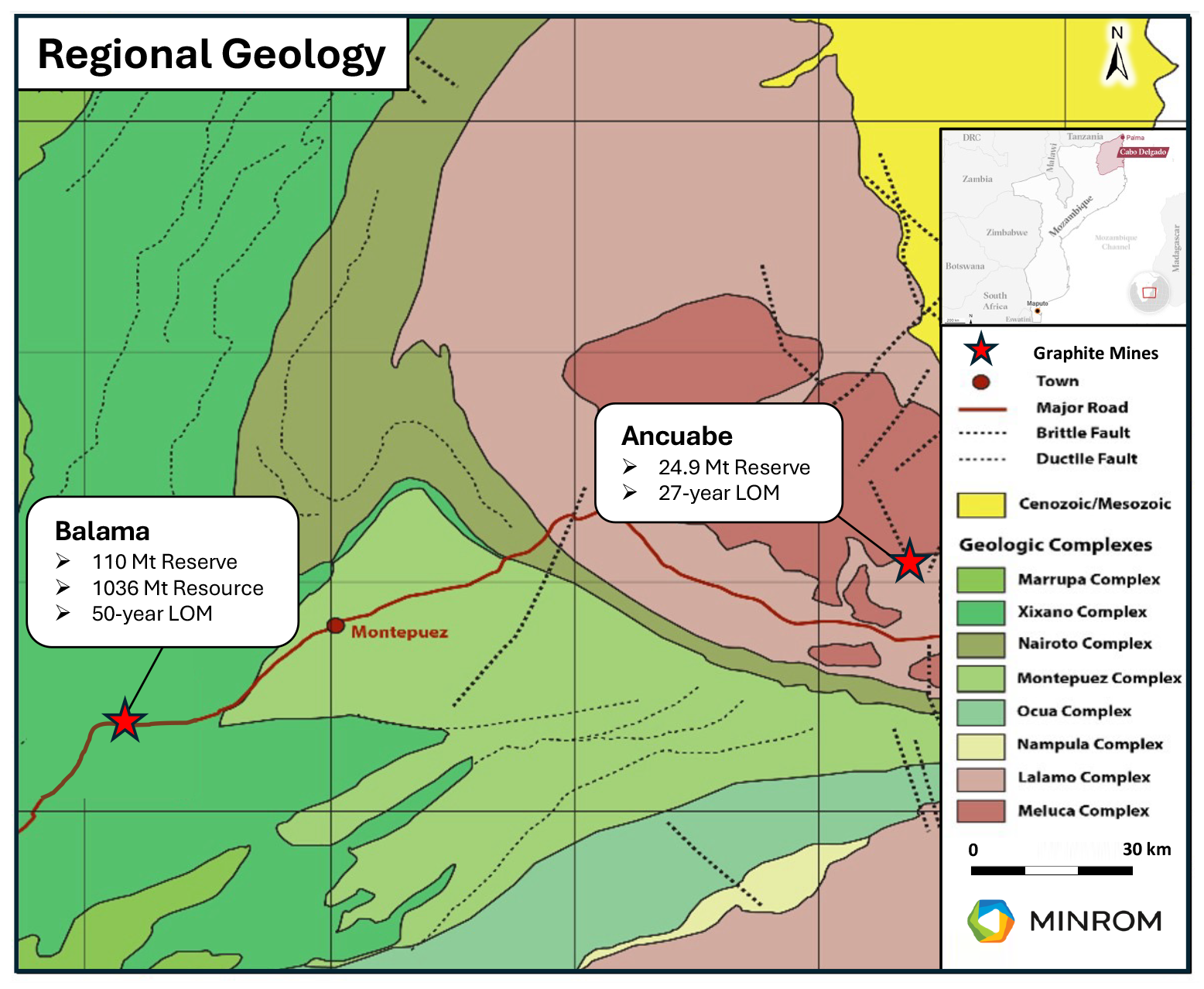
Regional geology of north-eastern Mozambique with locations of Balama and Ancuabe graphite mines indicated.
Regional Geology
Figure 1
Regional geology of north-eastern Mozambique with locations of Balama and Ancuabe graphite mines indicated.
Minrom performed a non-invasive exploration programme located in the Cabo Delgado Province, Mozambique investigating graphite and gold mineralisation. Mozambique is a proven graphite region with the country having an 8% share of global reserves and a 6 % share of global production. Balama and Ancuabe mines within the Cabo Delgado Province are significant producers of graphite, with Balama being one of the world’s largest known graphite deposits.
Geologically, the project is situated within the high-grade metamorphic complex of the Pan-African Mozambique Belt. These highly metamorphosed rocks have been overlain by Karoo sedimentary formations to the west and sediments of the Rovuma Group to the east. Syn-orogenic to post-orogenic plutonic intrusive rocks (pegmatites and deformed granites) are readily found throughout the region. Regionally, there are three (3) important lithostratigraphic units: the Xixano Complex, the Nairoto Complex and the Montepuez Complex.
The project is located within the Neoproterozoic Xixano Complex which is primarily composed of high-grade metamorphic units such as paragneisses, amphibolites, and granulitic rocks. On the local scale, target lithologies were regionally mapped graphite-bearing mica schist and gneiss units with some of these graphitic units also playing host to gold mineralisation. This mineralisation may represent an extension of that seen in the Niassa Gold Belt (NGB) in northern Mozambique.
The exploration programme developed and implemented by Minrom comprised of on-site geological mapping and geochemical sampling which included trenching over the identified mineralised zones. A subsequent airborne geophysical survey was implemented to assist in highlighting potential extensions to mineralised zones and identifying any additional targets within the project area. A follow-up soil sampling campaign was performed to assess possible mineralisation trends and narrow the prospective target areas for graphite and gold.
Photographic Data
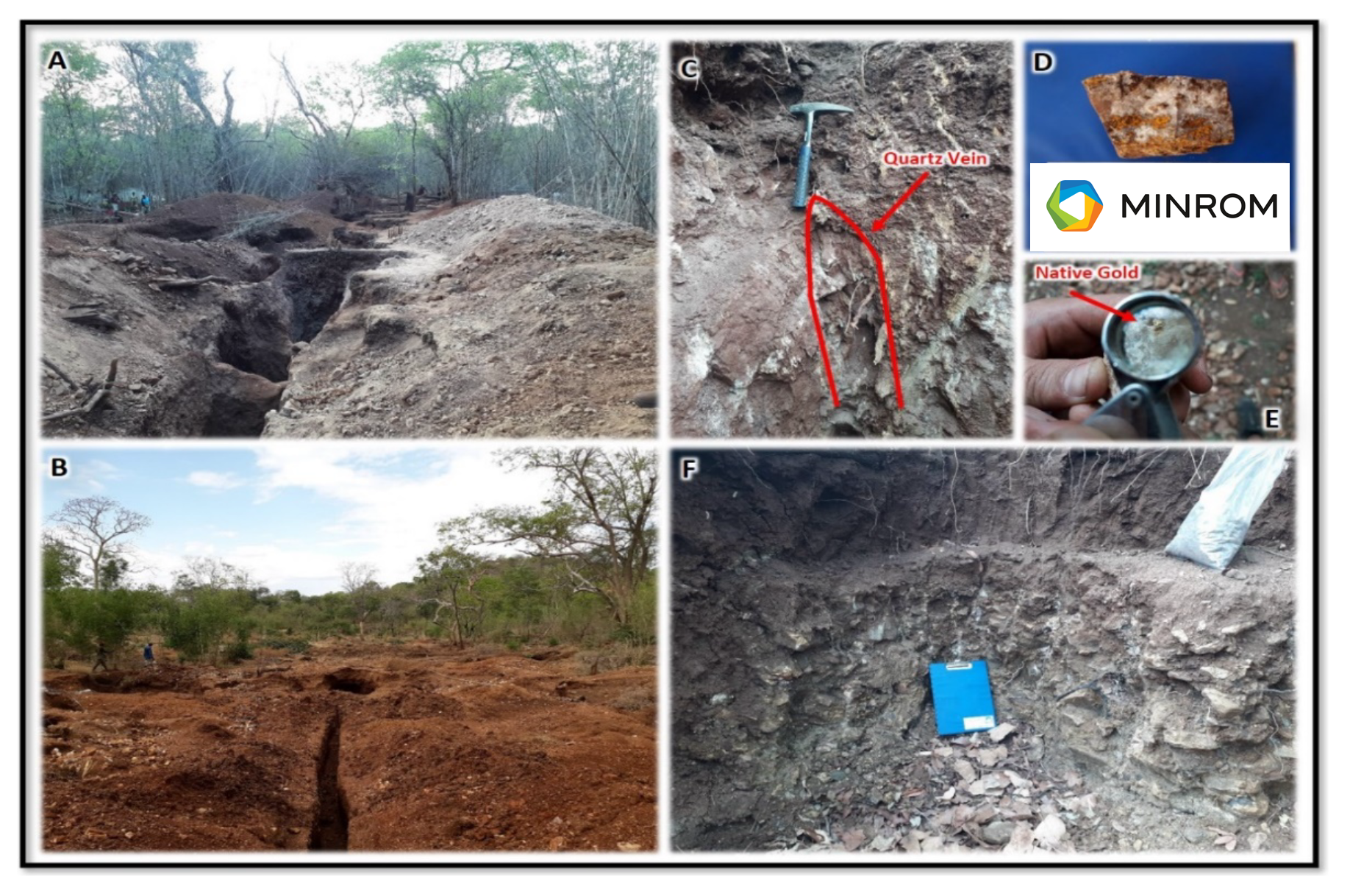
Figure 2
Field photographs of trenching on the project investigating gold occurences.
Several lithological units along with major structures and displacement lineaments were identified during this initial exploration campaign. The results from this work are very promising and Minrom has advised the client to perform additional trenching and pitting in target areas to investigate grade continuity. Further exploration will help assess whether mineralisation is comparable to that of other nearby deposits and can be mined economically.
Photographic Data
Several lithological units along with major structures and displacement lineaments were identified during this initial exploration campaign. The results from this work are very promising and Minrom has advised the client to perform additional trenching and pitting in target areas to investigate grade continuity. Further exploration will help assess whether mineralisation is comparable to that of other nearby deposits and can be mined economically.